
Damage and restoration efforts from August 11 storm
The August 11, 2026, derecho that hit Northwest Indiana, and the storms that followed, caused unprecedented damage to the region and to NIPSCO’s system.
We recognize the significant hardship that the prolonged outages caused for affected communities, and we have heard the questions and concerns from our customers. NIPSCO is focused on examining our response and applying lessons learned for future severe storms – to build a stronger electric system and stronger communities.
Our commitment: We will do better.
This storm will inform NIPSCO’s approach moving forward. We have hired an independent third-party expert to conduct a thorough review of our storm response, and we will release the results publicly.
This storm will also help all
of us think about how Indiana prepares for severe weather, which is becoming much more common. An event of this scale is not something a utility responds to alone. It requires coordination among the utility, state government, local leaders, emergency-management
agencies, first responders, and communities. We are committed to being a good partner and to engaging in this important conversation.
Customer Assistance and Resources
Frequently Asked Questions
What caused the outages?
We recognize the significant hardship that the prolonged outages caused for customers, families, and businesses, particularly in the region’s most heavily affected communities.
The outages stemmed from the widespread and severe storms, including an August 11th derecho that caused unprecedented damage across NIPSCO’s electric system.
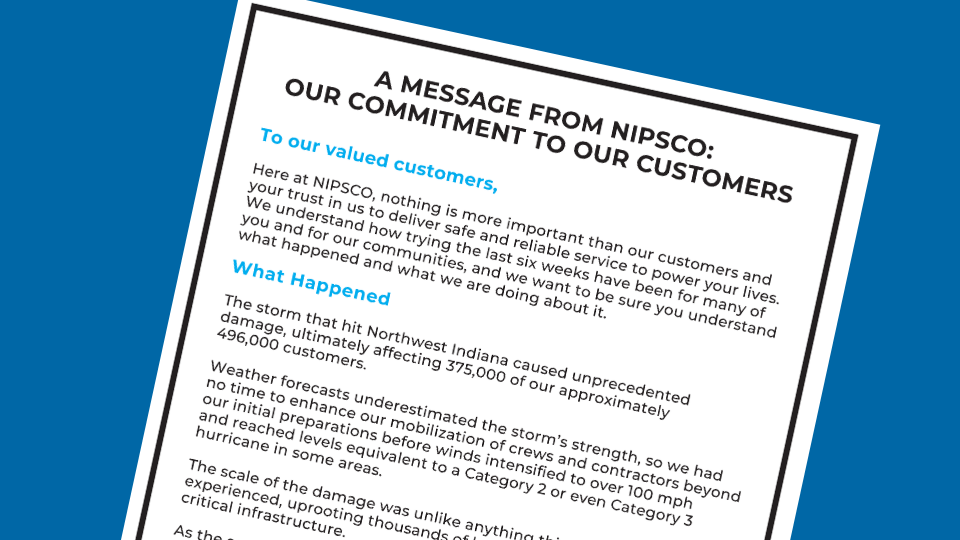
Weather forecasts underestimated the strength of the storm, which produced winds exceeding over 100 mph and reaching levels equivalent to a Category 2 or even Category 3 hurricane in some areas. This placed extraordinary stress on our electrical system.
The scale of the damage was unlike anything Northwest Indiana has experienced. It uprooted thousands of large trees and damaged critical infrastructure, including five transmission towers and approximately 1,500 poles, more than 15 times the average of our previous five major storms.
Thank you for your response.
Why did restoration take so long?
Every day following the storm, even as the severe weather continued, we focused on restoring service safely, supporting those affected, and helping our communities recover.
This was the largest restoration effort in our history – more than 4,000 internal and contract workers from 15 different states were mobilized to support the response. Our crews and contractors worked long days and nights under extremely difficult conditions, and we are grateful for their dedication and support.
The combination of extreme, sustained winds and highly saturated soil created conditions unlike anything our system has ever experienced.
The storm brought down huge trees and other infrastructure from outside of our right of way, making roads inaccessible in some areas and making it harder to assess damage and reach equipment that needed repairs, which ultimately impeded restoration.
Thank you for your response.
Did NIPSCO adequately prepare for the August 11 storms?
Yes. NIPSCO was prepared for what we understood was coming, and when the storm materially changed, we adjusted.
Beginning on Friday, August 7th, NIPSCO’s operations team met daily to track the weather and prepare for the storm. As we tracked the forecasts, NIPSCO initiated our storm preparedness protocols consistent with those forecasts.
On the morning of August 11th, we activated our Incident Command System, which is our emergency-response structure based on FEMA’s model. We had our internal line crews and existing contractors in place before the storm.
After the storm hit, and the extent of the unprecedented damage became clear, we rapidly scaled the response, bringing in roughly 1,000 additional resources on the ground by 7am the next morning. Within the first 24 hours of the event, more than 1,800 personnel and contractor partners were mobilized. This represented about six times our normal daily field presence.
Thank you for your response.
Does NIPSCO charge customers who experienced outages?
No. Customers are not charged for energy use while they were out of service. There are some recurring charges unrelated to energy usage that will appear on bills – but customers will not pay for electric service during outages.
Thank you for your response.
Did inadequate tree management practices contribute to outages?
No. The damage was caused by widespread and severe storms, including an August 11th derecho, that caused unprecedented damage across NIPSCO’s electric system. The damage went far beyond any trees in our right of way, and even a robust vegetation management program such as NIPSCO’s could not have prevented the extreme damage stemming from the August 11th storm.
Thank you for your response.
Why did restoration estimates for communities change?
This was a dynamic and evolving situation, as our crews worked tirelessly to assess damage and repair needs throughout our service areas.
As our crews on the ground gained access to severely affected places, they discovered more substantial damage than was initially visible. This led NIPSCO to provide revised estimated times of restoration to certain communities.
For other communities, we waited to provide estimated restoration times until we could substantiate a timeline for those areas. The wait had no impact on our restoration work, but we know it caused confusion and apologize for this mistake in not explaining what we were doing.
Thank you for your response.
Why did some communities experience longer outages than many neighboring communities?
This restoration effort was the largest in our history. The storm affected each community differently. But regardless of the community, our crews and contractors worked their hardest to restore power as quickly as possible.
There were a number of factors that affected the restoration timeline for different communities in our service area: the storm’s intensity, customer density, transmission impacts, access conditions, the infrastructure damage, and the percentage of the system affected, to name a few.
Thank you for your response.
Why are customers responsible for repairing damaged weatherheads?
Weatherheads are customer-owned equipment attached directly to the home or business and mark the point where utility responsibility ends and private property responsibility begins. If a weatherhead is damaged during a storm, it is the customer's responsibility to have it repaired by a licensed electrician before NIPSCO can safely reconnect electric service. This is not a new policy – it’s the way responsibility has always been apportioned.
Thank you for your response.
Are you making any changes to your storm preparation or response protocols in light of this storm?
We are committed to doing better.
NIPSCO engaged Filsinger Energy Partners (FEP), a nationally recognized expert in utility disaster mitigation and proactive program management, to conduct an independent third-party review of our response to the August 11th storm and our general storm preparedness. FEP has significant independent evaluation experience.
We expect the review to be completed by mid-to-late February 2027, and we will share the results publicly.
This review will inform how we prepare for and respond to the increasingly severe weather affecting the communities we serve.
Thank you for your response.
How are changing weather patterns affecting NIPSCO’s approach to preparing for storm?
Changing weather patterns are a reality.
Like other utility companies all over the country, we need to continue to harden our system so our customers have the safe and reliable energy they deserve in the face of these changes.
This will take sustained discussion with our customers, as well as our regulators, community officials, and first responders, to determine how best to balance risk with affordability and make changes that are effective and efficient.
We are committed to being a good partner and engaging in that conversation.
Thank you for your response.
Did reductions in force or labor issues affect preparedness or restoration?
No. NIPSCO continues to hire and invest in the workforce needed to safely operate and maintain our system.
We are grateful for all of our employees, which includes union members, who provided their support and worked around the clock to turn the lights back on in our communities.
Labor negotiations were completed in early May 2026 and had no impact on our preparedness or response.
Thank you for your response.
Did serving data centers have anything to do with restoration delays?
No. Serving data centers did not affect the restoration timeline. NIPSCO serves one active data center, which is located in an area that did not incur significant damage stemming from the storm.
Thank you for your response.
Need assistance?
Visit our customer support page.